What Breaks When 10,000 AI Agents Run for 48 Hours?
Third Moment Research says it runs up to 10,000 agents on investigations lasting 36 to 48 hours. The impressive number hides the harder problems: retries, token waste, security, evaluation, and human escalation.
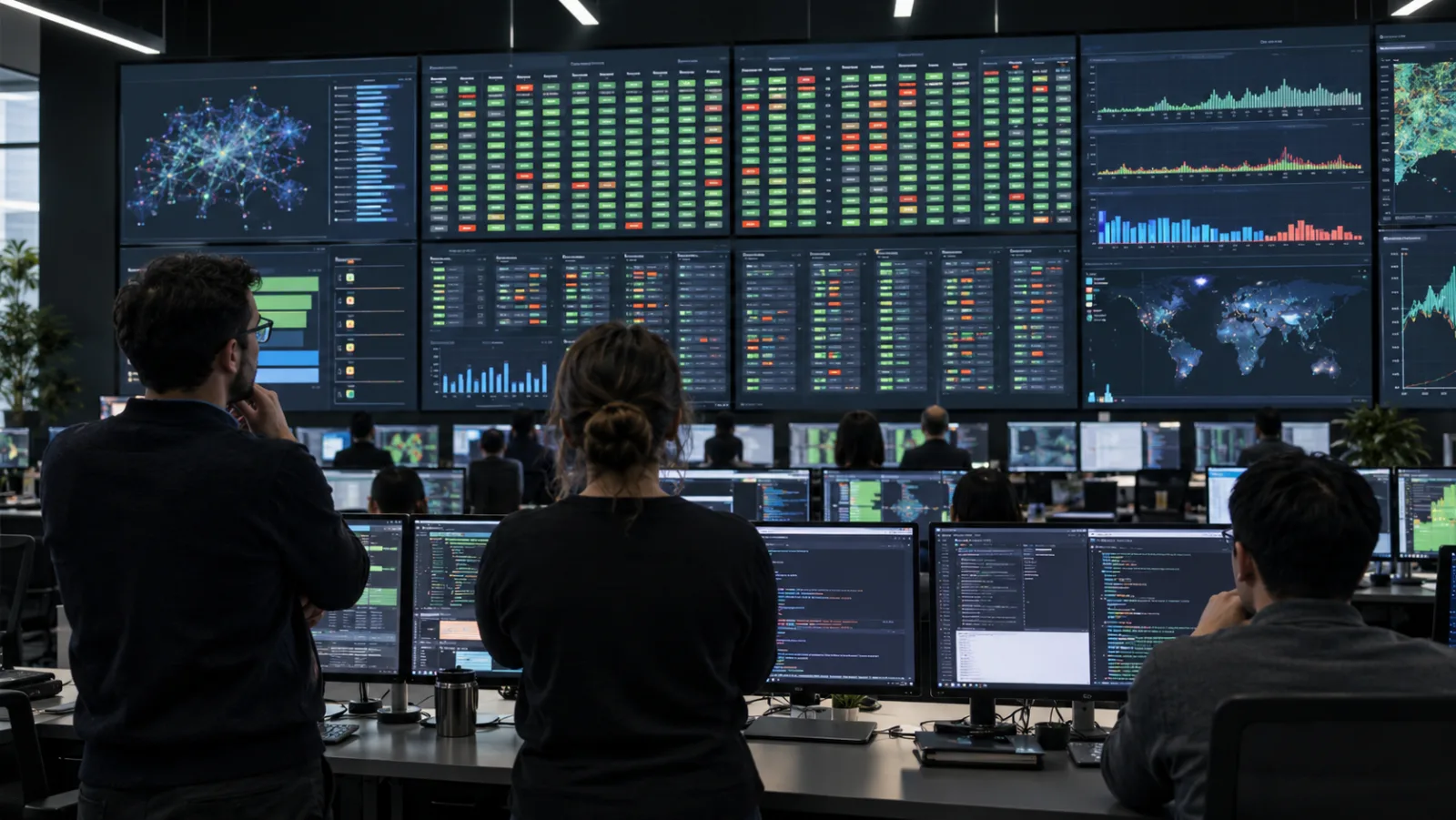
Third Moment Research says it can run 10,000 AI agents at once on investigations lasting 36 to 48 hours. That scale sounds like proof that autonomous research has arrived. It is better understood as proof that the main challenge has shifted from launching an agent to operating a distributed system full of agents.
The public case study comes from OpenAI and the customer, not an independent audit. It provides useful engineering details but does not disclose total compute cost, complete failure rates, human-review hours, or investment performance. Those missing numbers are essential to interpreting the headline.
That provenance matters more than it might seem. A vendor-and-customer case study is a marketing document with engineering footnotes: the parties have every incentive to describe the architecture accurately and no obligation to publish the numbers that would make the result comparable to anything else. Readers should treat the details as credible and the conclusions as provisional. The distinction between “the system did this” and “the system did this economically, reliably, and better than the alternative” is exactly where the undisclosed figures live.
What the 10,000 agents are doing
Third Moment uses agents for quantitative research and system optimization. They run experiments on historical data, evaluate trading hypotheses, inspect software, and use results to choose follow-up work. The environment includes a large research repository, extensive data, GPU-supported training, simulation, and specialized tools.
OpenAI says the system uses Codex as a working harness and stronger reasoning models for planning and long investigations. An outer controller examines unfinished trajectories and decides whether to retry, stop, or escalate to a human.
That outer loop is a crucial detail. Ten thousand independent model calls are not the product. The product is the control plane that gives each agent a bounded environment, records its actions, identifies failure, and prevents endless retries. In distributed-systems terms, the interesting artifact is the scheduler, the state store, and the escalation policy — the model is closer to a commodity component that the control plane directs. Anyone hoping to copy the result by pointing many agents at a problem will reproduce the model calls and none of the reliability.
The first thing that breaks: waiting
One example in the case study involved a backtest that took roughly three hours. Agents repeatedly checked whether it had finished, consuming tokens and filling their contexts with status messages. Codex reportedly found caching and memory-packing changes that reduced the runtime to roughly three to five minutes.
The lesson is broader than the speedup. Agents can waste large amounts of money while doing no useful work if asynchronous jobs are exposed through naive polling. Large fleets magnify small inefficiencies: a retry that costs cents becomes expensive when repeated across thousands of workers for two days.
A robust system needs event-driven completion signals, exponential backoff, hard retry budgets, job deduplication, and visibility into idle token consumption.
It is worth being precise about why polling is so corrosive here. Each status check is a full model turn: the agent re-reads its context, emits a message, and pays for both. A three-hour job checked every few minutes by thousands of workers turns idle wall-clock time into billable inference. The failure is not that the agent is dumb; it is that the interface between the agent and the job queue was designed for a human who checks a dashboard occasionally, not for a fleet that checks constantly. Event-driven notification, where the job itself wakes the agent on completion, removes the waste at the architecture level rather than asking the model to be patient.
The second thing that breaks: context
Long investigations accumulate experiment results, logs, failed hypotheses, code changes, and tool outputs. If every detail remains in the active context, cost and confusion grow. If compression removes the wrong evidence, the agent may repeat a failed experiment or draw a conclusion it can no longer justify.
The case study says the harness supports planning, subagents, and context compaction. What remains unclear is how often compaction loses decision-critical information and how those losses are measured.
Operators need durable external state: experiment registries, structured hypotheses, provenance, artifact storage, and explicit success criteria. A conversation transcript is not a sufficient research database.
This is the quiet failure mode that scale makes worse. A single agent that forgets a failed hypothesis wastes one afternoon. A fleet of thousands that forgets in different ways can re-run the same dead end hundreds of times, and no one notices because each individual trajectory looks locally coherent. The remedy is unglamorous: write results to a database the agent queries rather than a context window it rereads, tag every experiment with its inputs and outcome, and treat the transcript as a log rather than a memory. Compaction then becomes a cost optimization on top of durable state instead of the only thing standing between the agent and amnesia.
The third thing that breaks: evaluation
Parallel agents can generate thousands of plausible outputs faster than humans can inspect them. That creates an evaluation bottleneck. In quantitative research, a strategy that looks promising may simply exploit noise, leakage, or a flawed simulator.
Third Moment’s environment reportedly tests whether an improvement is meaningful, but the public story does not provide a complete methodology or audited outcome data. The claim that agents improved a baseline system therefore remains a company-reported result.
At scale, evaluation must be automated without becoming circular. Agents should not be the only judges of other agents. Deterministic tests, held-out data, reproducible runs, human escalation, and independent risk controls are needed.
The circularity risk deserves emphasis because it is easy to miss. If one model proposes a hypothesis and another model grades it, the two share training data, priors, and blind spots; agreement between them is weak evidence. Quantitative research offers a partial escape because some claims are checkable against held-out data and reproducible backtests, but even those checks inherit the assumptions baked into the simulator. The strongest evaluation stack combines cheap deterministic gates that filter obvious failures, held-out validation that resists overfitting, and human review concentrated on the small fraction of results that survive both. The bottleneck does not disappear; it moves to where judgment is scarcest and most valuable.
The fourth thing that breaks: security
Each agent receives tools, data, and an execution environment. Thousands of agents mean thousands of opportunities for a bad instruction, vulnerable dependency, unsafe shell action, or environment escape.
The case study says Third Moment uses OpenAI’s Daybreak system to test whether agents can escape research environments and access the broader network. That is evidence the team recognizes the risk, not proof that the environment cannot be breached.
Least privilege, network isolation, temporary credentials, immutable base images, complete audit logs, and human approval for irreversible actions remain essential. The more autonomous the fleet becomes, the less acceptable it is to rely on informal oversight.
The asymmetry of security failures is what makes this category different from the others. A wasteful retry costs money; a context loss costs time; a bad evaluation costs a wrong conclusion that can be revisited. A breach can cost all three at once, because an agent that escapes its sandbox may write to shared state, exhaust credentials, or corrupt artifacts that other agents depend on. Testing for escapes, as Daybreak reportedly does, is a useful adversarial check, but it samples the space of possible failures rather than proving its absence. The operational posture has to assume some agent will eventually do something unexpected and design so that the blast radius is small.
What the case study does not reveal
The biggest missing figure is cost. Thirty-six to 48 hours of parallel reasoning can consume an enormous number of tokens and substantial compute. The article says stronger reasoning can be justified when a useful financial signal is valuable, but it does not disclose the average cost per successful investigation.
Failure rate is also absent. We do not know how many investigations terminate early, repeat existing work, produce invalid results, or require human rescue. Nor do we know how much operator time is needed to maintain the orchestration layer.
Those omissions do not make the system unimportant. They define what a buyer or engineer should ask before treating it as a repeatable blueprint.
There is a reason these particular numbers are the ones withheld. Cost per successful investigation, failure rate, and operator hours are the three inputs that determine whether a fleet is cheaper than the humans it replaces or supplements. A system can be technically magnificent and economically marginal if most investigations end in nothing and the survivors require expensive supervision. The headline figure of 10,000 agents is impressive precisely because it is easy to state and hard to falsify; the missing figures are the ones that would settle the argument.
Verdict
Running 10,000 agents for two days is an impressive orchestration claim, not evidence that 10,000 digital researchers can be left alone. At that scale, waiting, context, evaluation, security, and cost become first-class engineering problems.
The most transferable lesson is not “launch more agents.” It is to measure useful work per token, bound retries, preserve evidence outside the chat context, isolate every worker, and define when a human must intervene. Scale amplifies intelligence, but it amplifies waste and error just as quickly.
For the reader weighing whether to build something similar, the practical takeaway is to start by instrumenting the boring parts. Track how many tokens go to waiting, how often state is lost, how many outputs survive review, and what a completed investigation actually costs. Those measurements will say more about whether a fleet is worth running than any benchmark of model capability, and they are the numbers the public case study leaves for you to find yourself.
Sources
> Want more like this?
Get the best AI insights delivered weekly.
By subscribing, you agree to our Privacy Policy. You can unsubscribe at any time.
> Related Articles
Control Room Can Halt Research Output in 35 Seconds—What Keeps Running?
OpenAI's Control Room puts research inference behind a central stop system. For builders, the hard question is what a stopped workload can keep doing.
OpenAI's Control Room Can Cut Off Research—What Does It Leave Running?
OpenAI's Control Room puts research inference behind a central permission check. For builders, the revealing detail is what a stop command leaves running.
Fable 5.2 and Mythos 5.2 Share a Core—So What Are You Choosing?
Anthropic's Fable 5.2 and Mythos 5.2 share an underlying system but different safeguards. For builders, the first decision is access, then the acceptance test.
Most Read
- 1 Kimi K3.1 Pro: China's Open-Weight Model Just Caught the Frontier
- 2 OpenAI Is Buying the Bottleneck: Can Orchestra Bio Cut a 15-Year Drug Timeline?
- 3 1,068 Tokens Per Second: Can Mercury 3 Change How LLMs Generate Text?
- 4 Same Price, Better Coding: How Good Is DeepSeek V4.1 Flash 1017?
- 5 Used OpenCode? Should You Rotate Your API Key After the Console Breach?





Latest News
- Decisions API Scores 1,000 Questions—Can Its Confidence Travel?
- Edge0-145B Promises Frontier AI on Your PC—Which PC?
- Hydrogen Starts at $1.50—What Will a Finished Task Really Cost?
- $0.10 per Million Tokens: Decisions API Has a Different Catch
- Control Room Can Halt Research Output in 35 Seconds—What Keeps Running?
- Huawei Released MACaQ—Will Its Quantizer Fit Your Local Stack?
Tags
> Stay in the loop
Weekly AI tools & insights.